

If you’ve ever finished the day rolling your shoulders, tilting your head from side to side, and pressing your fingers into the base of your neck for a moment of relief — you already know this feeling intimately.
It builds slowly. A dull tightness that starts at the top of the shoulders, creeps up the sides of the neck, and by evening settles into a stiff, heavy band that no amount of shrugging seems to shift. For millions of people, this isn’t an occasional annoyance. It’s the default state of their body — every afternoon, every evening, every night.
And here’s the frustrating part: you stretch, you apply heat, maybe you even book the occasional massage — and it helps… for a few hours. Then the tension returns, exactly where it always does. Understanding why is the first step to finally interrupting the cycle.
What’s Actually Happening In A “Tight” Neck
Your neck and shoulders are held up by a network of muscles that almost never get to fully switch off. Two of them do most of the suffering:
- The upper trapezius — the large, fan-shaped muscle that runs from the base of your skull across the top of your shoulders. Every time you hunch toward a screen, hold a phone, or carry stress, it stays contracted.
- The sternocleidomastoid (SCM) — the long muscle along the side of your neck that turns and tilts your head. When it’s overworked, it refers pain upward, which is why so much neck tension turns into a headache behind the eyes or at the base of the skull.
When a muscle is held in a shortened, contracted position for hours — which is exactly what happens during a day at a desk, behind the wheel, or looking down at a phone — the fibres don’t simply relax when you stand up. They stay partially switched on. Over time, tight bands and tender “knots” (what specialists call myofascial trigger points) form inside the muscle.
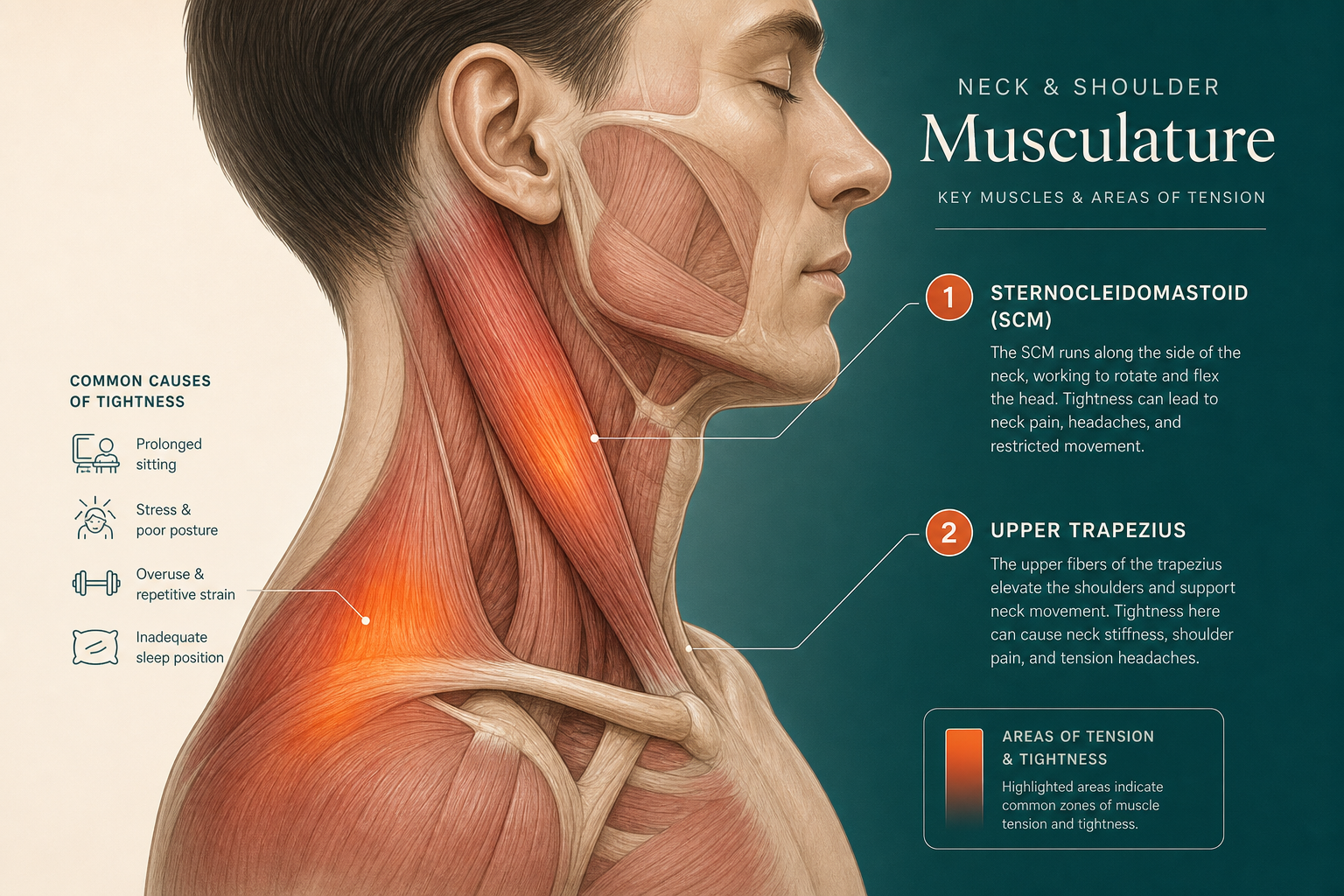
The tension you feel at 9pm was built up, layer by layer, across the whole day — which is exactly why a single stretch never fully undoes it.
Why Stretching, Heat & The Occasional Massage Fall Short
None of these are useless — they all bring genuine, temporary relief. The problem is that each one only reaches part of the picture:
- Stretching lengthens the muscle for a moment, but it doesn’t break up the tight bands sitting deep inside it. Minutes later the muscle draws back to where it was.
- Heat feels wonderful and increases blood flow to the area, but warmth alone doesn’t physically work the knotted tissue.
- A monthly massage does address the deeper tissue — which is why it works so well — but tension rebuilds every single day, and a treatment every few weeks simply can’t keep pace with it.
That last point is the one almost everyone misses. Tension isn’t a one-off event you can “fix” and move on from. It’s a daily accumulation. And anything you do occasionally will always be outrun by something that happens every day.
The Difference Between “Vibrating” And “Kneading” A Muscle
Here is where most at-home relief tools get it wrong. Buzzing, surface-level vibration feels pleasant on the skin, but it barely reaches the muscle layer where the actual tightness lives. It’s the equivalent of patting a knot rather than working it loose.
When a skilled therapist releases a tight neck, they don’t just vibrate the surface. They use their thumbs and knuckles to press, grip and roll the muscle — a technique called kneading, or petrissage. That deeper, circular pressure is what physically works through the tight bands and encourages the muscle to let go.
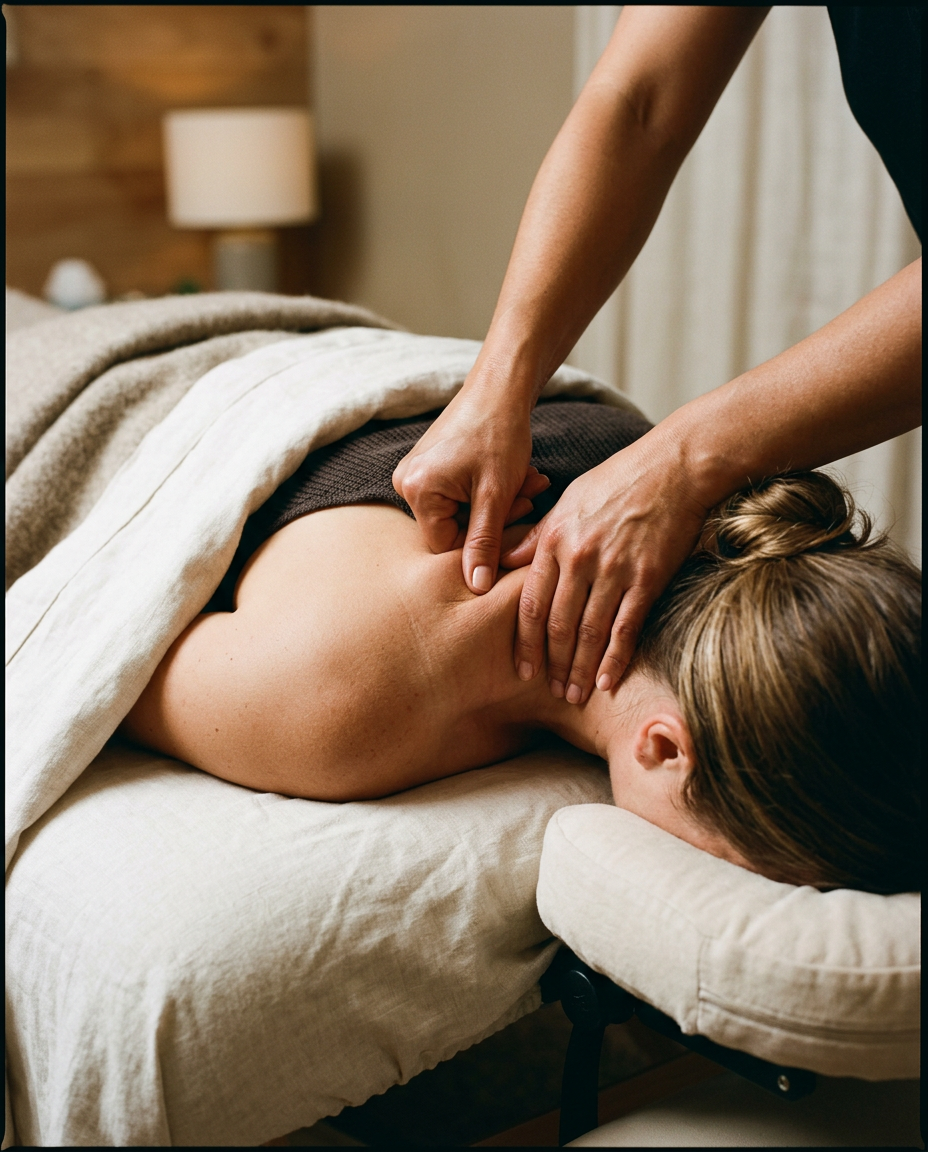
The Key Insight
Lasting relief isn’t about a stronger buzz on the skin. It’s about deep, kneading pressure applied to the right muscles — consistently enough to keep up with how quickly tension rebuilds.
Recognising The Signs You’re Caught In The Cycle
Does this sound familiar?
- A tight, heavy band across the tops of your shoulders by the end of the day
- Stiffness when you turn your head to check a blind spot or look over your shoulder
- Tension headaches that creep up from the base of the skull
- Knots you can feel with your fingers — and instinctively try to press
- Relief from stretching or heat that fades within an hour or two
- Waking up already stiff, before the day has even started
If you recognised yourself in three or more of those, you’re not dealing with a random ache. You’re dealing with a daily tension pattern that needs a daily answer.

What A Consistent, Deep-Kneading Reset Actually Does
When the right muscles receive deep, kneading pressure on a regular basis — rather than once in a blue moon — something shifts. The tight bands get worked through before they have a chance to harden into the next layer. Blood flow to the area improves. And the muscle spends more of its day in a released state than a contracted one.
The goal isn’t one dramatic session. It’s a short, repeatable few minutes of proper pressure applied often enough to stay ahead of the tension — the same principle behind why regular movement beats one intense workout a month.
- Target the real culprits — the upper trapezius and the sides of the neck, not just wherever aches most.
- Use deep, kneading pressure — the press-and-roll action that reaches the muscle layer, not surface buzzing.
- Keep it consistent — a few focused minutes most days will always beat an intense session once a month.
- Add gentle warmth — heat relaxes the tissue and makes the kneading more comfortable and effective.
Curious what a deep-kneading reset feels like at home?
See how everyday people are recreating that firm, therapist-style kneading pressure on their own neck and shoulders — in just a few minutes a day.
See How The At-Home Reset Works →How To Choose An Approach That Actually Keeps Up
If occasional relief hasn’t worked, the fix isn’t to try harder at the same things — it’s to change what you’re asking your routine to do. When you’re weighing up any approach, hold it against three simple questions:
- Does it reach the muscle, or just the skin? Deep, kneading pressure works; light surface vibration mostly doesn’t.
- Can you actually do it consistently? The best method in the world fails if it’s too much effort to repeat. It has to fit into an ordinary evening.
- Does it target the right muscles? Relief comes from working the trapezius and neck directly — not a generic rub across the back.

The Takeaway
Neck and shoulder tension keeps coming back because it’s built fresh every day — and most of the things we reach for only touch the surface, or happen far too rarely to matter. The muscles that carry the load, the upper trapezius and the SCM, respond to one thing above all: deep, kneading pressure, applied consistently.
Get that combination right — the right muscles, the right kind of pressure, often enough to stay ahead of the build-up — and the tight, heavy band you’ve learned to live with stops being the default setting of your body.
Ready to interrupt the cycle for good?
Discover the simple at-home way people are giving their neck and shoulders a deep, therapist-style kneading reset — whenever the tension starts to build.
See The Full Reset →